Hi everyone!
Here is a fantastic guest from Marcus, who wants to show us how 2 filofaxes used simultaneously works perfectly for him!
Enjoy!
MY TWO FILOFAX SYSTEM
As an Army officer I am, apparently, one of the
original target market for Filofax. I have been a committed 'user' since being
an Infantry Platoon Commander in 1996. I don't remember the model of the binder
I had at the time, but it was Personal Size with 2 sets of rings (duplex?) and
2 heavy duty press studs. In a time of limited computer use at Battalion level,
this served me well for many years. This was also a time when more Filofax
inserts were available. I actually had and used many that were available,
including the likes of the 'Soldier
Record Cards' to keep details of all my troops under command. As an Infantry
Company Commander, I now have have over 190 troops under command, more responsibility, a much faster pace of
life and the curse of Email. my organisation system has therefore evolved
considerably.
Anyway, scene setting – onto what works for me. My
system consists of 2 Filofaxes, an A5 and a Pocket. Currently, both are
Kendals, although the A5 was a City until recently. It had to be retired after
8 years of hard service (including two tours of Afghanistan!) and it now
reclines on the bookshelf in my office looking after all my spare inserts. The
Pocket Size is my analogue PDA and has been with me for 5 years now, hence the
colour difference in the photo below.

The A5 Filofax
This is primarily my work Filofax. During the
working day, I will have this to hand in the office, or in my daysack when I am
out and about. It provides me with room to scribble and therefore think. The
best thing about A5 size, is the ease with which I can print, punch and file
documents. Whilst this is also possible in personal size, every page requires
trimming, which can be a pain. In the Filofax I have the following:
ñ
Blank Notepaper – My 'Inbox' and capture tool when
at my desk. I use standard (non Filofax) quadrille paper which I punch to fit.
ñ
Actions, Projects, Waiting and Agenda tabs. These
are based on GTD and are mostly extracted from the DIY Planner kits. It is also
the most worked part of the Filofax and I can quite easily fill (but also cross
off) 2 sides of 'Next Actions' for the office in one day. This is also where I
keep track of tasks that I have delegated to my Platoon Commanders. Personally,
I find pure GTD too detailed, meaning I spend more time scouring my lists of
next actions than actually doing stuff. I have settled somewhere between the minutiae and the big picture
which seems to work for me. (I can expand on my system in a later conversation
if anyone is really interested).

ñ
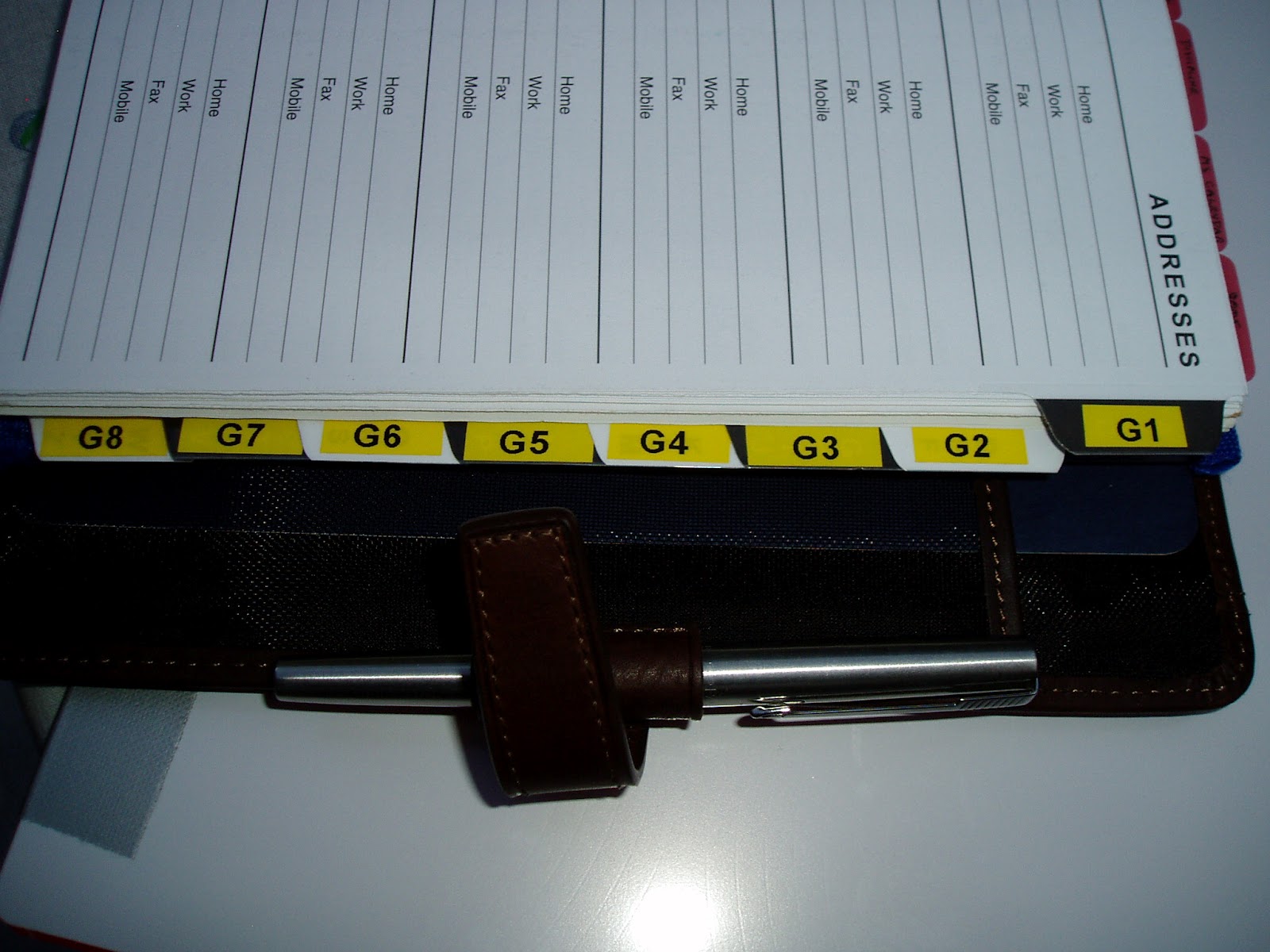
A Reference Tab (although I called it Info), which
has further tabs behind, dividing up information along Military Staff Functional
Areas. This is the information I need to hand most
days, either in the office, or in meetings, but probably not in between.
ñ
Towards the back are the ubiquitous card holders,
along with a zip wallet containing my passport and various other paperwork.
ñ
Finally, right at the back, in the pocket designed
for the Filofax Notepad, I keep a Moleskine Cahier for taking notes that I need
to keep. These will either be meeting notes, or the regular download from the
notes section in either the A5 or the pocket. I find that I am less 'prissy'
about cahiers than the posh notebooks, so am more likely to use it. I also find
that when using squared notebooks, you can rotate it 90 degrees and have almost
an A4 / letter sized page if you need yet more space to think.

The Pocket Filofax
This goes everywhere with me and is the core of my
planning function. Although it is not truly 'Pocket' sized, my uniform has
cargo pockets on the legs, which are designed for carrying notebooks and maps.
Out of uniform, I tend to wear cargo shorts in the summer and a jacket in the
winter. Carrying the Pocket Filofax is therefore not an issue. Because I always
have it with me, I always have somewhere to jot notes, or information I need to
hand. In it I have the following:
ñ
Blank notepaper, for jotting general information
and capturing ideas.
ñ
Actions, Projects, Waiting and Agenda tabs, as per
GTD. These are mainly for personal projects and tasks and although a duplicate
of the system in the A5, the contents are different.

ñ
A Reference Tab which has information I need to
refer to regularly (my Company Nominal Roll, Battalion Telephone List etc).
These are shrunk and punched to fit.

ñ
A Filofax standard week on 2 pages diary.
ñ
The standard card holders, containing stamps and
post-it page flags.
ñ
A clear slip envelope for receipts with a number
of Post-It style sticky notes.
With a few useful tips, tricks and hacks, the
pocket Filofax is almost enough to run my life, albeit in miniature. During my
most recent 7 months in Afghanistan I found that I very rarely used my A5.
Because the IT system was classified SECRET, printing and punching documents
was avoided. Therefore my pocket Kendal, a Moleskine Pocket Notebook and access
to the IT system, were all I really needed and helped me reduce the 'combat'
load when travelling. For those of you thinking about using a Pocket Filofax,or
struggling with one now, the following may help you get round the size issue:
Don't try to carry too much: Rather than carry a whole
year's worth of diary, carry a few months of week to view, and the rest on
month per page. You can still make a note of appointments far in the future,
but carry a lot less bulk. If you use day per page, again, carry 2 weeks worth
of DPP, a couple of months of 2DPP and the rest on month per page.
Carry an extra pen: Obtain a Filofax Flex slim pen
holder insert. Trim the top and bottom, so the pen loop is
central and punch to fit. Voila!

Handwriting: I use a 0.1 mm black ink drawing pen to
write, along with pencil for the diary. When taking notes, small handwriting is
still neat and tasks can generally fit onto one line of a Pocket sized page.
Make things stand out: Being slightly cramped, in
pocket size, sometimes your writing can look a bit jumbled. Go over completed
tasks with a blue highlighter. Your incomplete tasks will be far more obvious
than trying to identify tasks without a line through them. Use Post-It style page
flags to highlight important stuff. Write on the flag and put it wherever you
need to. (I use them to highlight important dates or tasks).


Diary Size: To prevent the diary from being too
cluttered, using pencil means that you can erase and rewrite, which takes up
less room than scribbling out and writing a second time. I also use Post it
flags to alert me to impending important events that may get lost. When things
get really busy however, I may print out a week's worth of 2DPP and insert it
where required, giving me more space. This format is available free from
Philofaxy, making it ideal to to mix and match at no extra
cost.
Daily Overview: To enable me to concentrate on the day
itself, I cut a single page of Pocket Sized paper in half and annotate the
day's appointments on one side with key tasks on the other. Again, if things
are really busy, a full page is more than enough. Following a recent idea by
Ray Blake of My Life
All in One Place however, I am tempted to hack his handy
tasks tab with times down one side and use it instead of
the today marker.

Over the years, this system has served me well.
During the last 18 months however, It has been tested to its limits. It is
during this time that I have experimented the most in order to try and improve
it and I think that this has helped me get the most out of the system. I think
that everyone's Filofax needs are different, both from person to person and
from month to month. It is OK to change up and down sizes, or use different
inserts as your needs see fit. I often wish that Filofax would take a look at
Apple and realise that the App Store brings in most of their money. Filofax
inserts could be analogue Apps. In the meantime however, I am glad for the
likes of Ray Blake of My Life
All in One Place, Steve Morton of Philofaxy and the folks at
DIY Planner to help fill a
need and provide some inspiration. Thank you for reading.
Marcus Myles
